Well, we did it. We hit a huge childcare milestone:
We no longer have any kids in daycare!
Don’t get me wrong, we still have plenty of childcare to pay for in the future. But with both kids now going to our local public schools, we no longer have a huge daycare bill every month.
We’re now “just” paying for aftercare to cover the time between when school ends for the day and when we are able to pick them up after work. And when summer rolls around next year, we’ll be paying for both kids to attend summer camp so they can do all sorts of fun activities and make new friends.
And for our kids, they got to see both of us enjoying interesting careers. And at daycare they received wonderful care, education, and guidance that helped them learn and grow. We looked to the teachers and staff at daycare as teammates, part of the village needed to raise kids. Their extensive experience and education in early childhood development meant our kids were able to learn both social/emotional skills as well as their ABCs and 123s. And we were able to work together to make sure our kids got everything they needed.
It wasn’t “paying someone else to take care of your kids”, as I’ve heard plenty of strangers on the internet try to assert. It was paying for peace of mind, knowing our kids were well cared for when we weren’t able to be around. It was paying for the expertise of their amazing teachers. We were still raising our kids, we just also got help from experts to make sure our kids got the best from all of us.
So, with a combination of the kids still being a bit young, then avoiding most social gatherings due to the pandemic, we hadn’t hosted a birthday party where our kids’ classmates were invited. The most we did for celebrating with friends was at daycare, where we sent in popsicles for everyone to share. But that was the extent of it.
So here we are, in 2023, and my daughter is old enough and the covid numbers are low enough that we feel like we’re ready to host a kid birthday party.
Many parties these days seem to be held at special party locations where kids are able to run around and bounce off of things. Play gyms, bouncy houses and slides, etc. We’ve gone to a few at local farms, which was pretty low key and had the added bonus of being low risk for covid by being outdoors. January isn’t the ideal time for an outdoor party, and I wasn’t really keen on one of those indoor play parks. Plus I didn’t start planning the party until a few weeks before her birthday, so the timeline on most of those options meant I was too late to even try to get a spot. So we went with a party at home!
Growing up, my mom always threw the most amazing birthday parties! There was usually a theme (based on our favorite movie/book/topic), with decorations, games, and a homemade cake all matching the theme. So I had a lot to live up to!
Discussing the party with my daughter, we settled on a theme: Outer Space! She’s big on science topics, especially space, so it seemed like a perfect idea. We started talking ideas for activities. Immediately, she suggested Pin-the-flames-on-the-rocket!
We got space-themed cups/plates/etc. from Oriental Trading company, and I totally lucked out at the grocery store where I found little 3oz paper cups with stars, astronauts, and rocket ships on them that were perfect for holding the various ingredients needed throughout the party!
First activity: Edible Constellations
I set out pretzel sticks and marshmallows (and M&Ms, because, why not?) and let the kids create edible constellations! Some kids used the reference materials to inspire them, but also encouraged them to just make whatever they wanted. Some kids did more eating than designing!
If the kids had been a bit older, I may have tried having them try to guess each other’s constellations (especially if they were one of the actual constellations). But they had fun and enjoyed the chance to be creative and eat snacks!
I came across a blog post showing how to make origami bookmarks decorated with little rocket ships. I made some stencils for kids to cut out all the pieces based on the drawings included at that blog post. I think the kids did a really awesome job!
After that, we had make-your-own moon pizzas! The moon is made of cheese, right? Or maybe the pepperoni look like craters? Really, they were just English Muffin Pizzas, but I gave each kid their own plate with english muffins pre-toasted and sauced for them. I used more of those little cups to give everyone their own cup of cheese, and also set out a few pre-cut toppings. The kids got add the cheese and their favorite toppings. I noted where on the baking sheet where I put everyone’s pizzas so everyone would get their own pizzas back after baking, then popped them in the oven. Then ~7 minutes later the little pizzas were out of the oven and ready to cool.
Pin the Flames on the Rocket
While we were waiting for the pizzas to cool, we played Pin the Flames on the Rocket! I drew and colored in a cartoony looking rockeship, and cut out some bright orange flames for each of the kids to use.
I baked and frosted a two-layer chocolate cake with dark chocolate fudge frosting (mixed with a little blue food coloring…not sure that actually made a difference), and did my best at representing the sun and the planets in our solar system. I served up the cake to the kids along with ice cream.
By that point, it was pretty much time for everyone to go. If we ended up with extra time, I had a back up activity where the kids could decorate rocks, creating their own “space rocks”. But that seemed unnecessary, as the kids were having plenty of fun!
I’ve always been a rule follower. Some may have called me a goody two shoes growing up. I never want someone to have a bad opinion of me. Which is honestly an exhausting way to live. I care way too much about what other people think.
But I’ve recently started caring a little less about what people think about me, at least in certain contexts.
I’ve started doing small things that make me happy, even if it may not be seen as the most professional thing to do. I just want to have fun while pushing against what people think should be considered “professional”.
I’ve been big on wearing silly/festive socks for awhile. I have socks for pretty much every holiday! And then quite a few just “fun” socks. I used to only wear them mostly hidden from view (in boots, or with long enough pants to reach the top of my shoe), so that it was kind of “my secret”. But at some point recently, I started wearing them with flats, so you could see a lot more of the socks. And it felt even more fun to have the socks visible.
My husband even signed me up for the Awesome Socks Club for Christmas, so I now get a new pair of, well, awesome socks every month! And the company sounds pretty great. The socks are designed by individual artists, and 100% of their profits go to charity!
My other, more obvious little rebellion, was coloring my hair blue. I’d heard about oVertone from Stephonee from Poorer Than You (here’s a tweet thread she shared about doing the whole process).
I’ve been using the Blue for Brown Hair on and off since November 2020, and every time I re-apply it, I love it even more!
This isn’t a sponsored post, but if you want to try out some fun colors for yourself, I do have a referral link.
I do want to say something about these “acts of rebellion”. I acknowledge the privilege I have in being able to do this. I’m a white, cis, hetero woman in a steady career. For many people, just living their lives may feel like an act of rebellion against the crueler parts of society. And my heart hurts thinking about people who are not allowed to be themselves at work, because employers or customers can’t handle that not everyone conforms to their narrow ideas of what a person should behave or look like.
So, hopefully my little acts of rebellion, in addition to making everything more fun, will also remind others that it’s okay to be themselves!
Well, 2020 started out relatively normal. And then all of a sudden, it was anything but. I didn’t blog much (which has been the case the whole time I’ve been a blogger), and when I did blog, a lot of it was covid–centric.
We were so fortunate in so many ways this year, and I wanted to take a moment to reflect on this. This year was hard for millions of people in this country alone. While the pandemic and everything else that came with it definitely impacted our lives, we still were lucky enough to get to 2021 healthy and employed.
As I’ve done in past years, I’m going to share some changes in various parts of our net worth for the year (2020), and muse on what may have impacted these categories of assets/liabilities.
Assets:
Total cash (checking and savings): went up. Which is good, since I’m continuing on the cash hoarding path a bit during the pandemic, even as interest rates on savings accounts continue to drop. The biggest impacts to these numbers are related to the pandemic: a decrease because I worked fewer hours, so I took home less money than I would have; and an increase because daycare was closed for months due to covid, and they didn’t charge us for that time, so we spent less this year on childcare. Now that daycare is back open, that expense is back as well. But hopefully I’ll be able to put in more hours at work to get more done and get paid more! Looking ahead this year, there will be a few changes to our childcare spending: my son will be moving up to the next age group, which costs less due to different teacher to student ratios. And, assuming regular in-person school happens in the 2021-22 school year, my daughter will be starting kindergarten and will no longer need full time daycare. She may need afterschool care, but we’ll see what’s available.
Investments: went way up. We contributed to our HSA, 401ks, Roth IRAs, and 529s. Technically the 529s aren’t “ours” (they’ll go to our kids when they’re ready) but for now since they’re categorized as investments in Mint, we’re calling them that. We contributed the maximum allowed for our HSA. We contributed beyond getting the match but NOT maxing out 401k. I increased my percent contribution by the same percentage as my raise, which kicked in right when the pandemic happened. We maxed out our Roth IRAs for 2019 in 2020, and, assuming the numbers look right, we’ll be doing the same this year (max out Roth IRA in 2021 for 2020). If it turns out we made too much for a Roth IRA (which I doubt), we’ll contribute to a traditional IRA. Just need to crunch the numbers. We put some money into both kids’ 529s but nowhere near the max. I only just recently increased our contribution amounts slightly when I was writing this review, since I had forgotten to do it and only remembered when rereading last year’s post.
Car values: wentdown. Which makes sense, as cars tend to depreciate in value. But we didn’t do a lot of driving this year once the pandemic started. So at least we saved on fuel and maintenance. I do feel a little silly that we bought a car in 2019 with the plan to do a lot of travel to family, and then in 2020 basically never go anywhere besides the grocery store and work. But hopefully it will be safe to visit family soon.
Home Value: went way up. The two assets that saw the most growth were our investment accounts and our home. Which seems ridiculous, but apparently home prices are going up a lot recently all over the country.
Debts:
Mortgage: amount owed went down. And then we refinanced our mortgage right at the end of the year, so hopefully we’ll make good progress this year!
2020 Net Worth summary
Overall, our net worth went up quite a bit. As I mentioned above that was pretty much because of our retirement accounts/investments and our home value.
Looking ahead to 2021
I’m trying to remain hopeful for a better year. Already glad knowing my parents have gotten their first dose of the Covid-19 vaccine, and hopefully the rate of vaccinations will increase, and we can get this pandemic under control.
Financially, we’re just going to continue on our working/saving/investing path. No big changes planned as far as I can tell. Here’s hoping for health and wealth in 2021!
We kept getting phone calls from our current mortgage company. They wanted to let us know that rates were lower and they thought they could get us a really great deal on a refinance. We kept ignoring these calls because it felt weird and predatory, and they always called when we were busy with something else.
Turns out, it was actually a good idea. Interest rates had in fact dropped quite a bit since we bought our house, so once they ran the numbers to show us our savings, we went forward with it.
I’ll admit, we didn’t shop around for the absolute lowest rates. But the good news is, with the lower interest rate, we’ll end up paying off our mortgage 4 years earlier than if we had stayed with our first mortgage, even if we don’t increase our monthly payments. Which feels pretty nice.
But there’s a relatively simple way to accelerate our payoff even more, without actively scheduling extra payments. We can switch from monthly mortgage payments to paying half of a mortgage payment every two weeks. This results in about 13 months of payments per year.
I ran the numbers in Bankrate’s Biweekly mortgage payment calculator, and it shows that if we switch to biweekly (as in fortnightly) payments, we’ll pay off our new loan an additional 2 years earlier and save an additional $18k in interest.
Of course, this option isn’t for everyone. You’ll need to consider if you can afford those extra payments, and check to see if your lender even allows you to do this. There’s a good post explaining why you may or may not want to do this. We decided that this path made sense for us because it’s not super aggressive to the point we’re missing out on investing options or having to forgo other things we want to do. It’s a happy medium between maintaining slow and steady payments and driving ahead with really aggressive payments. Plus, we can just automate it and forget about it!
Have you refinanced a mortgage? What were your requirements for moving forward with it? What is your mortgage payoff strategy?
Starting late in August, my kids were back at daycare.
I’m still a bit nervous. In our setup for those first 5+ months, we’d been keeping ourselves incredibly isolated. No visits with anyone, only me going to the grocery store once every 2 weeks, husband doing weekly contactless pickup at the local farm when our CSA started up. So our potential exposure to the virus has been kept quite low. With daycare, there’s an increased risk, but the center has instituted a lot of protocols that have been working at their other locations that they had kept open for frontline workers’ kids. With any interaction, especially with kids, there’s some risk of exposure.
And with the kids going back to daycare, my husband and I are going to work (masked and social distanced), so that’s another potential risk being taken. We’re both working from home as much as possible, but I’ve especially needed to go on site for research tasks in lab. I’m not happy at how much we’ve expanded our “bubble” with daycare and work, but we’re still limiting our other activities to avoid any additional risk.
Interestingly enough, their safety protocols ended up impacting us after just a week of school. I came down with a sore throat over the weekend, and that is one of the symptoms you have to report when you check in. So, kids couldn’t go to daycare until I could prove I didn’t have Covid-19 or until a set number of days had passed. I ended up getting tested for both Covid-19 and strep due to the sore throat. Luckily both came back negative, but the doctor wasn’t able to fully rule out covid in case of a false negative. Frustrating, because that meant the kids still needed to stay out of daycare longer, but I understand the risk they’d be taking (both doctor for signing a waiver and daycare for allowing our kids back). Luckily my throat got better, so the kids went back after the requisite time passed.
It’s good to know that they’re being extra careful, and I’m hoping all parents own up to their and their kids’ symptoms so that we can ensure a safer environment.
Of course I’m still worried. But I realized that the risks are lower with these health checks and smaller class sizes, and lots of cleaning, hand washing, and social distancing.
I know my kids are enjoying their time there and learning new things, even if there are some limits on what sort of interactions they can have with their peers and teachers.
I’ve already gotten plenty of feedback in the past from strangers on the internet that I’m a “bad mom” or a “selfish mom” for “paying someone to raise my kids for me”. I’ve acknowledged before and have seen again during this pandemic that the kids need more than just their parents in order to learn, develop social skills, and play. And I was struggling so much trying to balance the parenting with the working, and felt like I was failing at both. And yes, my husband was also doing parenting; we both felt overwhelmed and exhausted every day.
With kids back at daycare, my husband and I are able to focus on our work during the day and then be fully present with our kids mornings, evenings, and weekends. We’re still tired after a full day of work. I’ve found being on-site for work extra exhausting since I’m in a “high alert” mode trying to keep my mask on, stay distanced, and wash my hands enough while also doing work. Plus I end up not eating or drinking enough because it’s a bit trickier to do.
I fully acknowledge how fortunate we are to be able to find and afford childcare during this time. So many parents are not as lucky. And I very much appreciate our kids’ teachers and the risks they are taking. Gifts for the teachers are going to be bigger this Christmas!
What’s your current working and/or childcare situation? Still working from home? Never able to work from home? Homeschooling? What has helped you the most during all of this?
Hi. It’s me again. Yeah, I’ve been busy since my last post. When I foolishly assumed I could just “power through” and try to balance working from home with my husband and two young kids during a pandemic.
The kids are wearing pajamas during the day a lot more. My 4 year old tried cutting her bangs with the “kiddie scissors”. We’ve basically got PBS Kids and Disney+ playing on the TV nonstop.
And again, I have to remind myself how lucky we are at the moment. We’re healthy. We both still have our jobs and we’re both able to work from home. I know I’ll have to go back on site “at some point” to get back into the lab for some research, but my employer is encouraging most of us to work from home if at all possible.
Daycare sent us an email letting us know they’d be “reopening” at the end of August, with a re-enrollment starting at the beginning of August, with “first come first served” priority as well as a priority for full-time care, since they will have fewer spots available due to the new requirements imposed on childcare centers.
And I have no idea what we should do.
These past few months have been exhausting. Physically, emotionally. We’re both taking care of the kids, but my husband keeps getting invited to one work call after another, and so my somewhat flexible work schedule means I’m doing a lot more of the parenting during the day.
My prime working hours end up being after the kids are in bed, when I finally get some quiet time where I can focus. I can still get some work done during the day, but if there’s any work that needs lots of concentration, it will have to wait until then (unless my husband lucks out and can get out of hours of meetings so he can be with the kids while I find a quiet place to work in the house. But the kids still try to seek me out.)
But I’m not really okay with sending my kids to daycare. For every article claiming that “the kids will be fine”, I see plenty more pointing out how much we still don’t know about this disease, and its long term effects. We can’t guarantee that the kids will be fine, and we definitely can’t guarantee that they won’t transmit the virus to each other, the teachers and staff, or family members when they get back home.
I’m afraid for all my family and friends who are teachers, who may be forced to go back to working in the schools before it’s safe. I’m afraid for everyone who could be exposed to this virus unnecessarily because “we have to send them to school no matter what”.
And I completely understand that so many parents are trying to figure out what to do, and may have no choice but to send their kids to school. They need to work, the kids need care and teaching.
But right now I’m still trying to figure out how we can continue to “power through”. I know it’s not sustainable, and I’ve been finding myself burning out. In “normal times” I’d be sending them to daycare. But these are not normal times. There’s a highly contagious virus out there that we could catch. It could make us very sick. Or worse. Or we could transmit it to others who could fare worse than us.
So, what’s our plan when they send out the “welcome back!” email?
Let me preface this post by acknowledging how fortunate we have been during this. So many people are sick, dying, or out of work. Or they are forced to continue working in situations that put them at risk of catching the virus. We have been lucky enough to keep our jobs and be able to work from home. Sure, it’s been challenging keeping the kids occupied and happy while also trying to get work done. But that pales in comparison to some of the dangerous and frightening conditions and situations so many people find themselves in.
We are in an unprecedented situation and I’m trying to figure out how to keep a level head even as everything can get so overwhelming. I’m still figuring out how to keep my mind in the right place without spiraling.
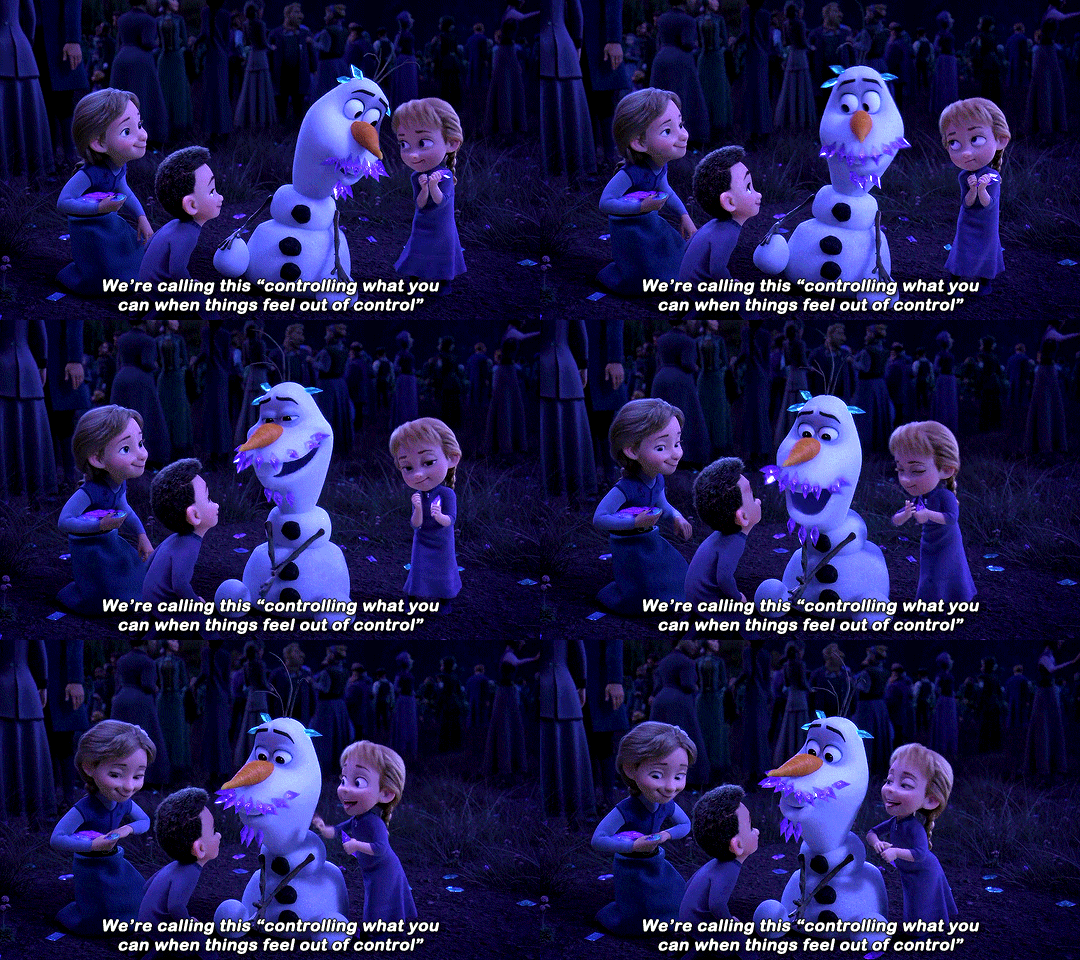
We’ve been watching plenty of Frozen and Frozen 2 these days (two kids under 5 years old) and every time I see this quote from Olaf, I think of how apt it is in these current times:
“We’re calling this ‘controlling what you can when things feel out of control’”
Many things I’m doing these days are just me trying to make things feel a little less out of control. Hopefully some of these things also have an actual positive impact on a broader group of people.
Number one, of course, is limiting our physical contact with anyone outside our family. I’ve shifted to grocery shopping only once every 2 weeks, rather than my usual once a week. The trips are more stressful as I navigate the aisles trying to avoid people and get enough food to last us for the next two weeks. And making sure my homemade mask stays put on my face. But limiting those trips helps reduce the chance that we could get/spread the virus. I’ve considered trying the delivery services but time slots are hard to come by and I’d rather let folks who are higher risk or otherwise unable to go grocery shopping have those time slots.
I haven’t set foot at work in over a month (again, we’re lucky enough that we can do a good amount of work at home. I’m not working in the lab right now, but I’m getting a bunch of other things done). It’s definitely a juggling act trying to keep the kids safe and happy while trying to do at least a little bit of teaching (whether it’s practicing writing letters with the older kid or identifying colors and shapes with the younger kid).
We are trying to stay in contact with as many people as possible. So far it’s lots of FaceTime with family and texting with friends. I’m trying to reach out to folks I haven’t heard from in awhile; I’ve found that catching up has really helped both me and the people I’m talking to. We all need to talk! The kids have even been able to have zoom meetings with their daycare classmates, which has been fun for them.
We try to get outside on the nice days. Whether it’s a quick walk, or just having a snack outside with the kids, some sunlight and fresh air (and a little bit of exercise) gets us feeling better.
I’m growing a victory garden. Angela at Tread Light Retire Early had a great post about this. I’ll admit, my garden is basically a sad attempt at getting just a little bit of fresh produce to make me feel a little more secure in our food supply. In a true food crisis, a few tomatoes or pea pods aren’t going to save us. But it helps me feel better having this extra bit. I’ve planted some seeds from some tomatoes we had, and have found some seeds packets I had stashed away that I will try to plant soon. We’re still signed up for our local farm’s CSA, and the last we heard, they’re still planning on doing it, and have added a curbside pickup option to reduce potential viral transmission. So we will hopefully have access to fresh produce one way or another!
I’ve started composting. Well, really at this point it’s more of a squirrel buffet than a compost heap. I’d been meaning to get an actual composter from the town for awhile now (they offer ones at a discount) but it sounds like I won’t be able to get one from our local DPW until the end of May. But I’m getting into the habit, and I like reducing how much we are throwing away. And if we actually get some good compost out of this, it will help with that victory garden.
I’m raising money for Walk For Hunger. I’ve done the Walk for Hunger quiteafewtimes and was going to sign up again this year until they cancelled the event (for obvious reasons). Project Bread turned it into a virtual fund raiser, and I decided to sign up for that. This is a cause I really care about: making sure our most vulnerable neighbors have access to healthy food. Especially now, with so many more people out of work, we really need to help feed folks. Here’s a link to my fundraising page if you’d like to contribute.
How are you coping with the chaos and uncertainty? What has been hardest for you? What has helped you the most?
(Disclosure: The Amazon links in this post are Amazon affiliate links. You can read more about this on my Disclosures page)
Okay, the title might be a bit extreme. But as I’ve mentioned before, I hadn’t really thought about FIRE (Financial Independence, Retire Early) as something we would do. But about a year few ago, a new book came out about FIRE that caught my interest. The book is Work Optional, by Tanja Hester. Surrounding the release of her book, there were plenty of articles in both news sites as well as personal finance blogs.
A few articles in particular got me thinking a little too much!
One of the articles discussed one of the reasons Tanja and her husband Mark wanted to retire early. They wanted to be able to do things sooner, before Tanja’s illness progressed to the point where her options became more limited. This article got me anxious about running out of time to enjoy life! What am I doing wasting time on work?
The other post was at Tread Light retire early. It was Angela’s review of Tanja’s book. She reviewed the book, but also delved into the part that asks you to consider what you would do with your time. And then prompted her readers to answer that the question: “What do you want your life to look like?” And I felt like I had no idea. My response was basically to live a more relaxed (less stressed) life.
A combination of thinking about these ideas and a little bit of postpartum depression (and also listening to The Good Place podcast which talked a lot about the meaning of life and other heavy topics) led me into quite the meltdown one night. I started wondering: what is the point of anything? What’s the point of working or advancing in your career (besides earning money) if your goal is to retire early? Should I optimize my life for saving money? For earning money? What do I even enjoy? Am I running out of time? What am I doing with my life?
Oof. I definitely was spiraling there…
Well, the good news is I started feeling a bit better. I took advantage of my EAP again for some free therapy sessions. So I was able to talk through some of my PPD and my concerns about trying to figure out what I actually enjoy. Turns out, once you become a busy mother of two, you tend to get lost in just making sure the kids are cared for, fed, and sent to bed every night rather than concerning yourself with pursuing your own interests.
All of this to say: after a year of Tanja’s book being out, I finally finished reading it. The book itself didn’t give me existential dread, so that’s good! There was a whole section early on in the book where you were asked to brainstorm about what is important to you, what you would do if you had the time to do it, etc. and I actually sat down and made the list for myself. Which helped remind me that I do in fact have interests and goals for my life. Phew.
I also found her book helpful in general to understand the ways that people can pursue FIRE. I always felt a bit lost trying to catch up on FIRE bloggers’ steps towards FI or FIRE. But the book shares various ways that you can make progress towards a work optional life. There were tips on growing your income, reducing your spending, how you can invest, and how much you should actually be saving to reach your goals. Overall, it was very useful whether or not you are planning on retiring early!
I still don’t think I’ll be pursuing early retirement, but I feel like I know a bit more about how to continue to build our wealth and identify what I want for my future, including getting a better idea of near term vs long term goals. I very much admire so many folks in the FI and FIRE community, including Tanja and Angela and so many others. They and others have found a great path that helps so many others!
Have you read Work Optional by Tanja Hester? What other books and resources have helped you?
I went ahead and reviewed my net worth changes for 2019, just like I did at the end of 2018. Our net worth went up a lot more this time compared to last time. Which is exciting. But pretty much all of that increase was due to the stock market. In the grand scheme of things that seems good, because if I see significant gains in my investments, then I’m on track for being financially independent, right? Letting my money make more money for me?
Maybe.
So yes, the biggest increase in our net worth came from the gains in the stock market. And also from contributing to our 401ks and IRAs. When I logged into my 401k on December 31, 2019 (like the personal finance nerd that I am) it said my personal rate of return on that account was almost 26%. This is bonkers. It still slightly worries me seeing that growth because, hey, it could also have gone down 26%. Volatility makes me nervous, but we’ll stick with it and keep investing through the ups and the downs.
Let’s review all the money categories:
Assets:
Total cash (checking and savings): went down. Which could be expected, since we made 3 big purchases and pulled money out of our “sinking funds” to do it. The good news about this drop (if you can call it good news) is that the drop in cash was $X thousand (keeping it a mystery) smaller than the amount we spent on the purchases. Translation? If we hadn’t made these big purchases (and we don’t plan on these same expenses any time soon), our cash would have increased by about $X thousand. (alternatively, we probably can put about that extra amount into retirement accounts next year) So, here’s hoping we don’t have too many big expenses in 2020!
Investments: went way up. We contributed to our HSA, 401ks, Roth IRAs, and 529s. Technically the 529s aren’t “ours” (they’ll go to our kids when they’re ready) but for now since they’re categorized as investments in Mint, we’re calling them that. We contributed the maximum allowed for our HSA. We contributed beyond getting the match but NOT maxing out 401k. I plan on increasing my percent contribution by the same percentage as whatever my next raise ends up being, so I won’t see much of a difference in my paycheck. We (kind of) maxed out our Roth IRAs (I think actually we both still need to contribute for 2019 (before tax day), but we contributed the max in 2019 for 2018). We put some money into both kids’ 529s but nowhere near the max. This is an area we need to re-evaluate, since at the rate we’re currently contributing, their accounts wont be super helpful when it come time for them to access the funds for school.
Car values: went up. Which is not surprising, since we bought a new car. But since we don’t actually intend on selling the car, and we plan on driving it for as long as it will let us, it’s kind of a silly number for us to pay attention to. My car has quite a few miles on it, but we’ll build up another sinking fund for when we eventually need to replace it. Hoping both cars give us a lot of years of safe driving!
Overall, we could be putting more money into our retirement accounts, but of course we have two quite large monthly bills. Living in a high cost of living (HCOL) area like we do, things end up being a lot more expensive (plus, you know, a bit of lifestyle inflation). Between our house and daycare, we spend A LOT.
In fact, a few weeks ago I tweeted out how much we spent on childcare in 2019:
Just reviewed the numbers: amount paid for childcare for our two kids in 2019: $45,841.80
💸💸💸
Yep. You read that right. Almost $46k for daycare last year. And it’s going to be similar again this year. We wont see a big decrease in childcare spending until our son moves up to the next age group at daycare, or when our daughter starts kindergarten at the local public school. So we probably won’t be maxing out our 401ks or paying extra on our mortgages until we have more wiggle room in our budget.
As a side note, that tweet generated A LOT of conversation. “Conversation” may be generous in some cases, as a lot of comments came with some pretty rude remarks about me and my choice to work rather than stay home with the kids. Many couldn’t believe daycare could cost that much. Also a lot of people seemed to think I was asking for advice? I was not.
Mortgage: Only slightly less since most of what we paid was interest and taxes (oh, the pains of those first few years of a 30-year mortgage!). I look forward to the days when our payments will go more towards principal than interest…
So, how do I feel about 2020? We’ll be making a few small changes, but honestly I don’t have big plans to change things. So much of my finances are on autopilot now, so we basically will keep on the same path for now. I know we’re doing well, which is quite a lucky situation to be in.
How did your 2019 go, moneywise? Or in other categories? What are your big plans for 2020?




 Graduated Learning: Life after College
Recent Comments